
Little Rock, AR · Garage Door Service
When the Power Goes Out, Your Opener in Little Rock Goes With It
Little Rock's 1980s-90s housing stock and cold-moderate winters mean opener failures hit hardest during power outages. Here's what that combination means for your garage.
- Repairs & new doors
- Springs & openers
- Serving 8 nearby communities
What Local Conditions Do
Most houses across the Little Rock service area went up between 1975 and 2001, with the bulk of that stock dating to the 1980s and 90s across the 17 named areas we cover. That matters for one specific reason: openers installed during that build-out predate battery backup as a standard feature. When the power outages, which happens here during winter weather in a cold-moderate climate band, the opener simply stops. No chain movement, no light, no remote response. The door sits wherever it was when the grid dropped.
This isn't a defect. It's just the era those garages were wired in. A single circuit ran to the opener, nothing more, because nobody built in a backup requirement at the time. Thirty-plus years later, a lot of those original units are still running, and a lot of owners don't know their opener has no battery until the first cold-weather outage leaves a car stuck in the garage. The age of the housing stock and the climate band aren't separate issues here. They compound.
What Most People Get Wrong
The common assumption is that a dead opener during a power outage means a broken opener. Most of the time it doesn't. The motor is fine. It just has nothing to draw on once the circuit goes dark, because the unit was never built with a battery backup module in the first place. People replace openers that didn't need replacing, or they call it an electrical problem and wait on an electrician who finds nothing wrong with the panel.
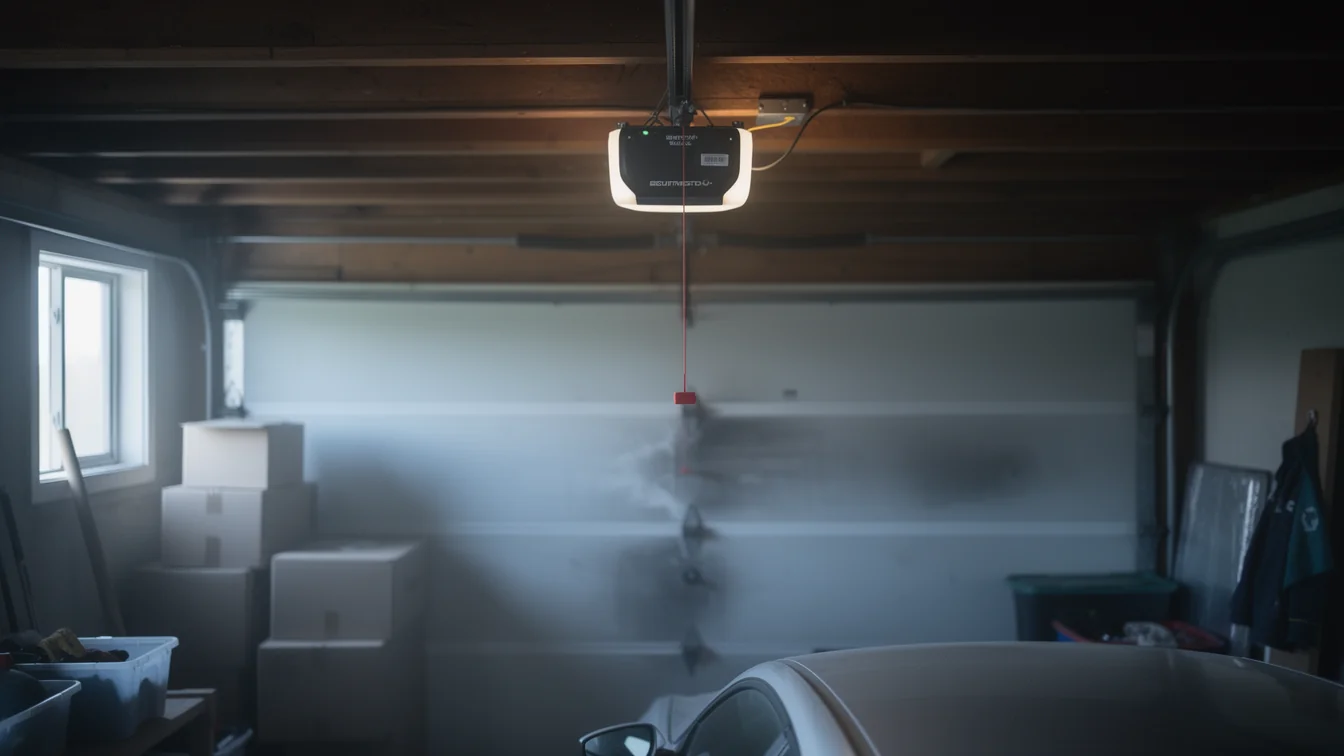
The other mistake is treating the manual release as a last resort instead of the first move. On a door this age, the release cord still works exactly as designed. Pulling it disengages the opener carriage so the door can be lifted by hand. Owners who don't know that end up waiting out the outage instead of just opening the door themselves for the five minutes it takes to get a car out.
A third miss: assuming the spring and opener are a matched pair that fail together. They don't. A torsion spring from the same 1980s-2001 build era can still be balanced and fine even while the opener itself is at the end of its working life.
What to Look At First
Start with the opener's age against the house. If the house falls in that 1975-2001 build range common across this area and the opener looks original, check for a battery backup unit mounted near the head bracket. If there isn't one, that's your answer for why a power outage leaves the door dead rather than just slow.
Next, check the wall switch and the wiring run to it. Houses from this era often ran opener power off the same general circuit as garage lighting, not a dedicated line. That's not a code violation for houses built then, but it means a tripped breaker elsewhere in the garage can look identical to an opener failure.
Last, look at the manual release cord itself. On an opener that old, the cord sometimes gets brittle or the mechanism sticks from years of no use. You don't want to find that out during the outage, with the door stuck and the cord not pulling.
The Problem
Here's the honest part. We don't do electrical panel work, and if your power outage is tripping breakers on more than the garage circuit, that's a call to an electrician, not to us. What we can tell you is whether your opener's design is the reason the outage takes the door down, and whether a battery backup retrofit makes sense for a unit that old or whether the opener itself is close enough to the end of its life that replacing it outright is the better money.
With 46,149 owner-occupied houses in the service area built mostly across that same 1975-2001 stretch, this isn't a rare situation. It's just that most owners don't think about it until the lights go out and the door won't move. At a median household income of $69,525 here, a battery backup add-on is usually the cheaper fix than a full opener swap, but it only works if the rest of the unit still has service life left in it. If it doesn't, adding a backup to a motor that's already failing just delays the real decision.
Frequently asked questions
Why does my garage door opener die the moment the power goes out?
If your house falls in the common 1975-2001 build range for this area, your opener was likely installed without a battery backup module, since that wasn't standard equipment then. No backup means no power to the motor once the grid drops, regardless of how healthy the opener otherwise is.
Can I still open the door by hand during a power outage?
Yes, on nearly every opener from this era. Pull the manual release cord hanging from the carriage and the door disengages from the motor, letting you lift it by hand. Check that the cord pulls freely before you need it in an emergency, since older releases can stiffen with age.
Is adding a battery backup worth it on an older opener?
Usually, if the motor itself is still sound. It's a lower-cost fix than full replacement and solves the specific problem of outages during cold-weather months. If the opener is already near the end of its working life, though, a backup just delays a replacement you'll need anyway.
Does my home's wiring age affect this?
It can. Houses built across the 1980s-90s commonly ran the opener off a shared circuit with garage lighting rather than a dedicated line. That doesn't cause outages, but it can make a tripped breaker elsewhere in the garage look like an opener failure when it isn't.
Related garage door services in Little Rock
More garage door guides
Book garage door service in Little Rock
Call now or request a quote - tell us what the door is doing and where you are.