
Little Rock, AR · Garage Door Service
Why Little Rock's Garage Doors Fail the Way They Do
A look at why Little Rock's 1980s-era housing stock and cold-moderate winters put a specific strain on garage door torsion springs and openers right now.
- Repairs & new doors
- Springs & openers
- Serving 8 nearby communities
What Local Conditions Do
Most of the housing across this service area went up between 1975 and 2001, with the median landing around 1985. That matters because torsion springs are rated for a cycle count, not a calendar date, and a spring installed when a house was built in the mid-80s has been through four decades of door cycles by now. Across the 17 named areas we see work in, from Boyle Park and Hillcrest close in to Benton and Jacksonville further out, the pattern repeats: 1980s and 90s construction, original hardware still hanging in a lot of those garages.
The climate here sits in a cold-moderate band. We don't get the sustained deep freeze that cracks steel further north, but we do get hard cold snaps, and steel contracts fast when the temperature drops quickly rather than gradually. A thirty-five-year-old spring that's been fine all fall can let go on the one morning it drops into the 20s overnight. That's not a defect. That's metal fatigue meeting a cold snap at the same time the spring was already near the end of its life.
This isn't a reason to panic every winter. It's a reason to know roughly how old your spring is before the cold decides for you.
What Most People Get Wrong
The most common mistake we see is treating the opener as the problem when the spring is the problem. A door that's gotten heavy to lift by hand, or that the opener strains on, groans on, or stalls halfway up, is almost always a spring losing tension, not a motor wearing out. Owners replace the opener, the door still binds, and the real issue - a spring that was already overdue - never gets addressed.
The second mistake is scheduling by season instead of by age. With 46,149 owner-occupied houses sitting across a service area of 98,038 households built mostly in the same twenty-five year window, a lot of springs are aging out in roughly the same stretch of years. Waiting for a visible problem means waiting for a snap, usually on a cold morning, usually with the car trapped behind a dead door.
The honest limitation here: we can't tell you over the phone how many cycles are left on a spring. That needs eyes on the coil, the wear on the winding cone, and the rust pattern, in person. Anyone who gives you a firm answer without looking at the door is guessing.
What to Look At First
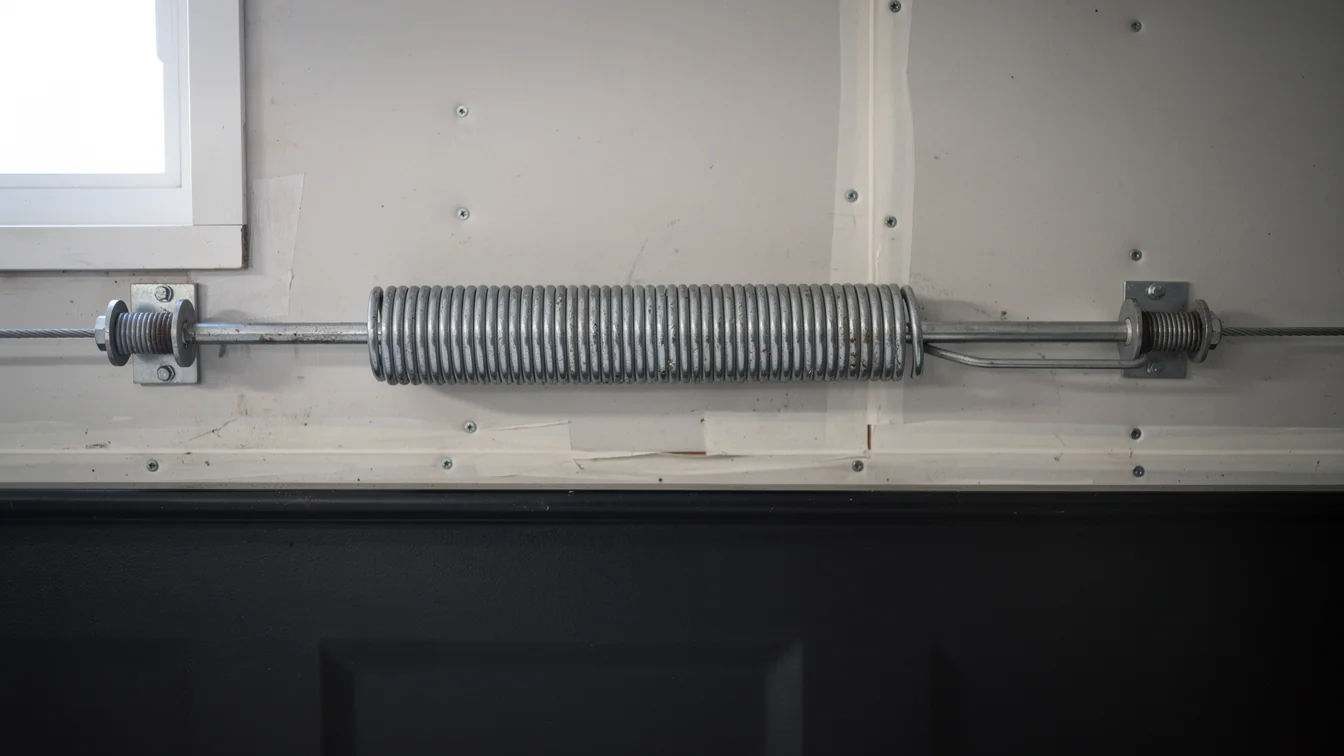
Start with the spring itself, not the opener. If it's a single torsion spring above the door, look for a gap in the coil - a visible separation means it's already broken, and the door is running on the opener alone until someone fixes it. If the coils look intact but the door still feels heavy, that's tension loss, which is harder to spot by eye and easier to catch by how the door behaves disconnected from the opener.
Next, check the date if you have any record of when the house was built or last had door work done. Given that median construction year of 1985 across this area, a spring with no record of replacement is probably original or close to it. That alone is worth a look even if nothing's broken yet.
Last, at a median household income of $69,525 in this area, most owners are weighing a spring repair against a full opener or door replacement, not writing a blank check for whichever contractor shows up first. Knowing which part has actually failed - spring versus opener versus track - changes that math a lot, and it's the first thing worth nailing down before you call anyone.
The Problem
Put the pieces together and the pattern is clear: a housing stock concentrated in the 1975 to 2001 window, a median build year of 1985, and a climate that delivers occasional hard cold snaps rather than steady winter cold. That combination means spring failures here cluster in two situations - age catching up with original hardware, and a sudden temperature drop finding a spring that was already near its limit.
It's not a crisis. It's a maintenance window that a lot of owners in this area are sitting in right now without knowing it. A door built in the same era as the house next door is probably running on the same era of spring, and the fix, when it's needed, is usually a straightforward spring swap rather than a full door replacement - unless the track or panels have taken damage too, which is a separate call entirely. We won't tell you to replace a door that just needs a spring, and we won't tell you a spring will hold if it won't.
Frequently asked questions
How do I know if my garage door spring is original to the house?
If you don't have a service record showing a replacement, and your house falls in the common 1975-2001 build range for this area, it's reasonable to assume the spring is original or close to it. A spring that old has likely been through tens of thousands of cycles and is a candidate for failure, especially during a sudden cold snap.
Why does my door act up specifically when it's cold out?
Steel springs lose a bit of tension and become more brittle as temperatures drop, and this area's cold-moderate climate means temperature swings happen fast rather than gradually. A spring that was already near the end of its life is more likely to fail on the morning of a hard cold snap than on a mild day.
Is it cheaper to fix the spring or replace the whole door?
That depends on what else is worn - track, panels, rollers, the opener itself. A spring-only repair is almost always the cheaper route if the rest of the door is sound. We don't push full replacement unless the door actually needs it.
Related garage door services in Little Rock
More garage door guides
Book garage door service in Little Rock
Call now or request a quote - tell us what the door is doing and where you are.